
Book one · A Victorian romance
In Her Own Hand
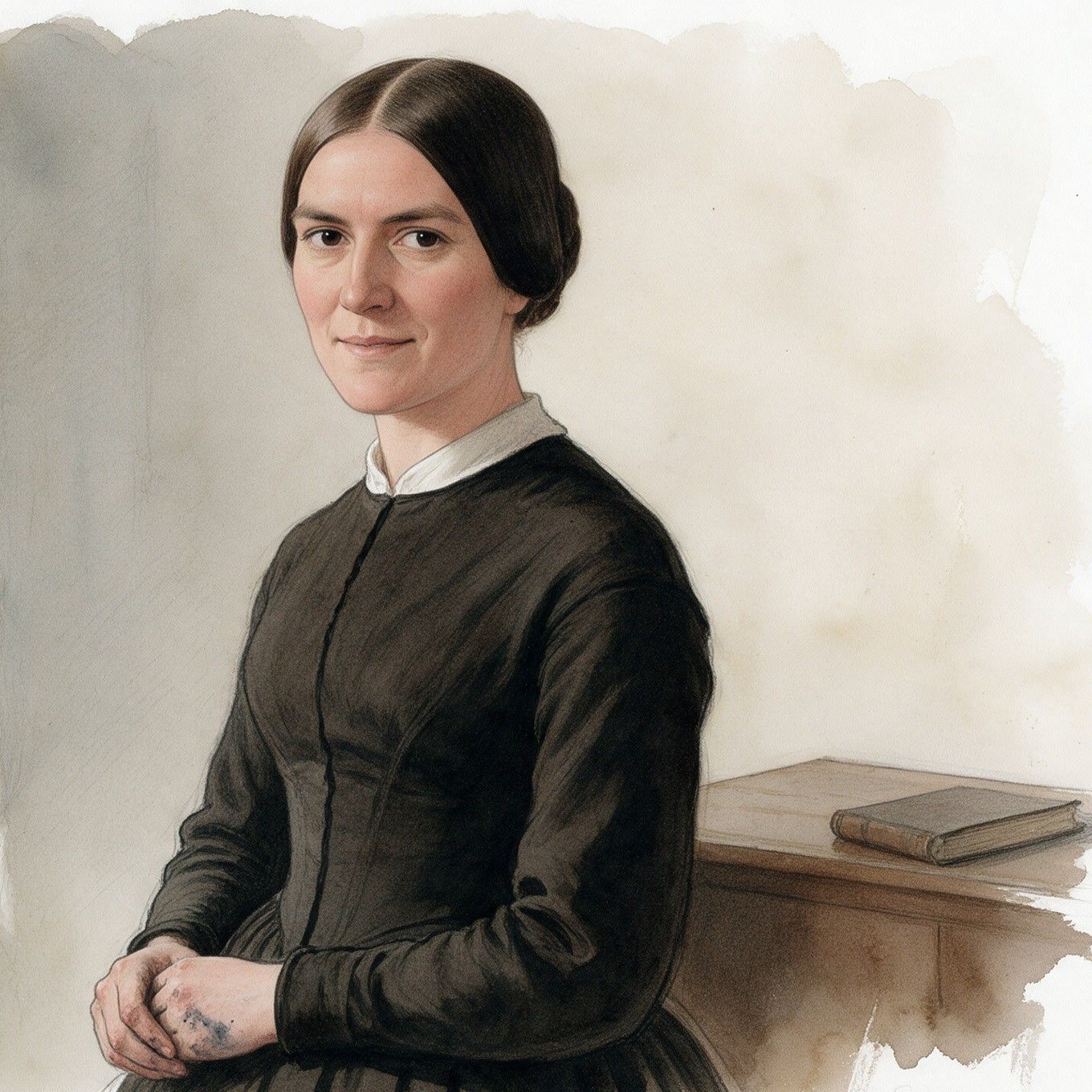
Lancashire, 1844. Esther Ormerod has kept the books of Low Bank Mill for nine years, and since the winter she has run the whole of it, every loom and every wage, in the name of a father who can no longer speak. The law lets an unmarried woman do that. On the morning of her wedding, every shilling of it would become her husband's.
Then a superintendent of factories comes to her gate. Daniel Corbett believes nothing he has not gone to see, and on his first night he tells her he does not believe her books.
A slow-burn, clean romance about a woman nobody looked at properly, and the one man who did.
Chapters
Each chapter starts the player above at its place. The whole book runs 2 h 52 min.
- 0:00Introduction
- 1:08Chapter 1: The Man Who Had No Right to Pass
- 10:32Chapter 2: What the Register Did Not Say
- 18:17Chapter 3: The Drawer That Was Not Hers
- 27:15Chapter 4: A Date at the Foot of the Page
- 36:02Chapter 5: Forty Hands and Their Minutes
- 43:51Chapter 6: What He Said in the Weaving Shed
- 51:49Chapter 7: The Pen He Could Not Ask For
- 1:03:14Chapter 8: The Sum That Would Not Come Out
- 1:10:51Chapter 9: What He Refused to Write
- 1:22:30Chapter 10: Everything a Husband Would Own
- 1:31:39Chapter 11: The Room Where the Rule Is Not Written
- 1:40:54Chapter 12: The Report With One Thing Missing
- 1:48:53Chapter 13: The Leaf Under the Coal Account
- 2:00:47Chapter 14: The First Night He Was Allowed In
- 2:10:22Chapter 15: Fined the Same as a Man
- 2:19:47Chapter 16: In His Own Hand
- 2:31:28Chapter 17: Nothing to Ask You With
- 2:39:32Epilogue: What the Act Required
- 2:48:15A note on the history
- 2:50:45Closing
Read Chapter One
Hear it read aloud, or open it below and read along.
Open Chapter OneFold Chapter One away · about 7 minutes
Chapter One
The register lay closed on the counting-house desk at half past seven, which said as much as any entry in it could have. Esther Ormerod had ruled every page of it in her own hand for nine years, and she had not needed to open it since Saturday to know what was in it.
Rain had been at the chimney since before light, driving smoke back into the grate in short, ill-tempered gusts. Through the window the street cobbles stood in a skin of it, black and shining under the one gas lamp the Improvement Commissioners’ rates still paid to keep lit at that hour.
From the spinning block came what a Tuesday had sounded like for as long as she could remember: the drum and creak of the mules running out, the upright shaft turning in its bevel wheels floor above floor, all of it driven by one engine two floors below. In twenty-nine years she had never once heard it stop before six.
Upstairs, behind a door kept shut against the noise he could no longer be troubled by, her father sat in the chair by his cold grate and said nothing, because he had said nothing to any purpose since the third week of December.
The surgeon had called it an apoplexy, and had gone on calling it that on each of his weekly visits with the patience of a man repeating a word until it would take. Whittaker called it a stroke, when he spoke of it at all, which was seldom. Esther had settled on the surgeon’s word for her own use, not because it sounded kinder, but because it was the truer one, and vague words left too much room for other people’s opinions to grow in them undisturbed.
Josiah Ormerod could stand, and walk a little with an arm to lean on, and understood, she was nearly certain, everything that was said to him. He could not make his mouth answer it.
His name still stood at the head of every page. Since December everything under it had been hers alone, and no one in Hollinbrook had yet found the courage, or perhaps the cause, to say so to her face. At Michaelmas the bank’s bond would come up for renewing, as it came up every third year. The bank had lent the money for the self-actors, the three newer mules on the top floor that ran out on their own gearing, and held the machines against it. It had always taken the yearly credit on her signature, but it had only ever taken the bond on his, and a bond left unsigned was a loan the bank might call in, machines and all. That was six months off. She had not yet let herself count them.
She was totting the coal account a second time, out of habit rather than doubt of the first sum. Two pages back, in the margin beside the balance for the quarter before December, her father’s initials stood where he had set them, J.O., the last he had set anywhere. She had turned past them without looking when a shape crossed the archway that was not one of the carters.
The archway ran through the counting-house itself, the only door the yard had ever had, so that nothing came in or went out of Low Bank Mill without first passing her window. She had long ago stopped remarking on how much of the business she conducted without leaving her chair.
A tall man in a dark, plain greatcoat had stopped just short of the gate proper, a flat leather case under one arm, and was saying something to Whittaker that the glass and the rain reduced to shape without words. Whittaker had planted himself square in the archway’s narrow throat, the way he planted himself in front of a green hand about to feed a full bobbin too near a moving carriage, and was not moving.
Esther set down her pen and eased the casement a hand’s width.
She caught only the tail of it, a voice pitched to carry over rain and not much else. “…Corbett. Sub-inspector of factories for this district, under Mr. Horner. I have come to look over the mill.”
“You’ve come to look at nothing today,” Whittaker said. He did not raise his voice either; it was not his way to need to. Twenty years running Josiah Ormerod’s floor had given him the particular stillness of a man who had never once had to shout to be obeyed. “The Act you’re standing on gives your rank no right onto the works, Mr. Corbett. Says so plain enough for a magistrate to read it to you, if you’d like it read. You’ll want the Inspector himself for that, and he’s a deal further off than this gate.”
“He is,” the man agreed, as if Whittaker had confirmed something rather than refused him, “and I am here. The mill gearing on your top floor wants fencing under the new Bill whenever it passes, which by the papers this week looks a near thing indeed. I thought I might save us both the trouble of my coming back once it is law to find it still bare.”
“When the Bill’s an Act, Mr. Corbett, you may come back and say so. Till then you’ll take the road you came on.”
It was said without cruelty, in the tone of a man reading out a weight from a scale. It was also, Esther knew from three readings of the same Act over three winters, entirely correct. A sub-inspector had no right onto the works. An owner, or whoever stood in an owner’s place, was under no compulsion to let him onto them, and had every ordinary reason not to. A stranger loose in a mill yard might see a strap unguarded or a boy where a boy oughtn’t be, and make a note of it that cost money for a year.
She had watched Whittaker turn away peddlers, temperance men, and once a bailiff with less patience than this. There was no reason on the page in front of her to feel that this refusal, alone of all of them, sat wrong.
She felt it sit wrong anyway, and did not trouble herself to ask why before she was already reaching for her shawl.
The rain had thinned to a fine, persistent mist that beaded rather than fell. She went down into the archway with her ledger hand still faintly grey from the coal account, and saw at close quarters that the sub-inspector was younger than his voice through glass had suggested.
His hair, where his hat did not cover it, was dark and wet, and cut shorter than any man in Hollinbrook would have troubled to wear it. The weather had got into his face the way it got into a carter’s, and stayed there. He walked from mill to mill on his own legs rather than kept a gig, and it showed: mud to the ankle, boots resoled more than once. He took her measure in the time it took her to draw one breath, the way she imagined he took the measure of a line of figures. He said nothing about her being a woman come out into a wet yard without a bonnet, which she noted and, cautiously, credited to him.
“Whittaker,” she said. “That will do. I’ll see Mr. Corbett myself.”
Whittaker did not move from the archway at once, and for a moment she thought he would argue it in front of a stranger, which he had not done in all her years at the desk. “Miss Ormerod, the Act’s plain on it. You needn’t—”
“I know what the Act says. I am not obliged by it. I am choosing.” She looked past him to Daniel Corbett, whose attention had not shifted from her once since Whittaker had used her name. “The law doesn’t require me to let you in, Mr. Corbett. It also doesn’t forbid it. Come out of the wet and say what you’ve come to say where I needn’t shout it across a yard.”
He looked at her a beat longer than the question required, as though revising some private estimate of her upward and deciding not to say so. Then he inclined his head, precisely, and followed her back through the archway into the dry.
He set his case on the corner of her desk and unbuckled it in three practiced movements, the straps falling away before she had finished drawing breath to object. He looked, not at her, but at the closed register under her hand.
“I shall want to see your register, Miss Ormerod. The time-book, as the Act has it.” He looked up. “If you are choosing.”
Low Bank Mill, Hollinbrook. First attendance.
Attended this 26th day of March, 1844, in the matter of the mill gearing on the upper spinning floor, which stands unfenced at present and will require fencing under the Bill now before the House, should it pass into law in its present form. Was refused admission to the works at the gate by the overlooker, Amos Whittaker, correctly, there being at present no right of entry to the works vested in my rank under the Act of 1833. Was subsequently admitted, at her own instance and upon no claim of right, by Miss Esther Ormerod. Miss Ormerod conducts the business of the mill during her father’s incapacity, he being disabled by an apoplexy since the winter, and the concern is administered in his name by his daughter until such time as his recovery permits him to resume it. The time-book was produced upon request and without demur. I have given notice of my intention to return and complete the inspection of the works at the earliest date my circuit allows, and have been given no cause to expect obstruction upon that occasion.
D. Corbett, Superintendent
The history behind it
- Under the Factories Act of 1833, the inspectors' paid assistants, called superintendents and soon known as sub-inspectors, could enter a mill's counting-house and schoolroom, but not the rooms where the work was done.1, 2
- The Factories Act of 1844 gave them the right to enter any part of a factory. It came into force on October 1, 1844.2, 3
- The 1833 Act says that its words for a man extend to persons of either sex, so its rules for the occupier of a mill applied to a woman as much as to a man.1
- A child's age for mill work was whatever a certifying surgeon judged it to be. Civil registration of births began in 1837, but parents had no legal duty to register a birth until January 1, 1875.2, 4, 5
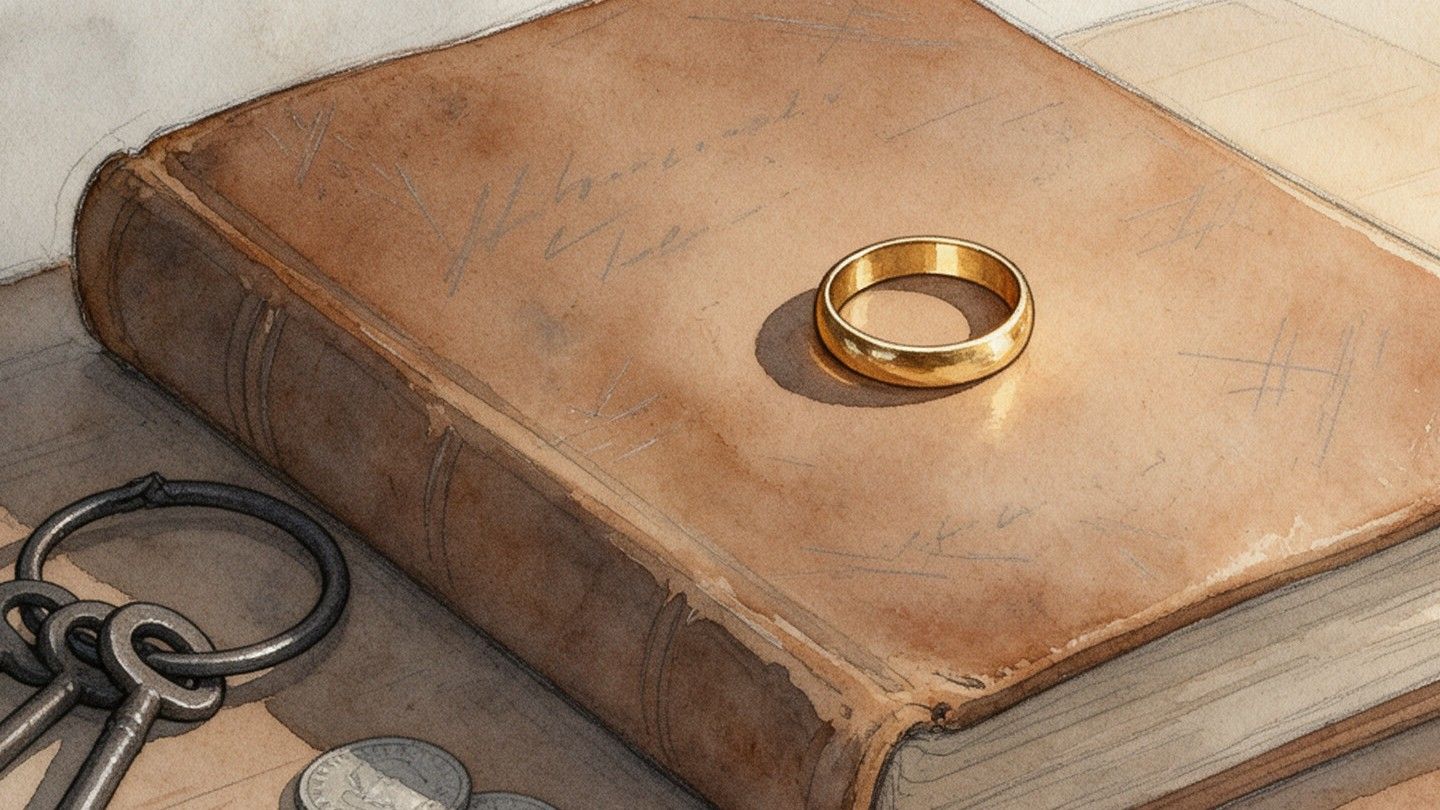
- Until the Married Women's Property Acts of 1870 and 1882, a wife's money and goods passed to her husband when she married.6, 7
- Esther is invented. No unmarried woman running a Lancashire cotton mill in the 1840s has been found by name, and none is known to have been prosecuted as the occupier of one. The law around her is real.
The full note on the history is read at the end of the audiobook, at 2:48:15.
Who's who
- Esther Ormerod
- Twenty-nine. She has kept Low Bank Mill's books for nine years, and now runs the whole mill in her father's name.
- Daniel Corbett
- Thirty-five. A superintendent of factories, who believes nothing he has not gone to see.
- Josiah Ormerod
- Esther's father, the mill's owner, who has not spoken to any purpose since a stroke in December.
- Amos Whittaker
- The overlooker, who has run the mill floor for twenty years.
How it was made
Our stories are written with AI tools, then read and corrected by human editors, with the history checked against period sources. The narration is an AI voice, and the watercolor illustrations are made with AI, for each story only. How we make Emberley Hall.
Sources
- Factories Act 1833 (3 & 4 Will. IV c. 103), s. 18 (the superintendents' right of entry) and s. 49 (words of the masculine gender extend to either sex); full text at Education in the UK, https://education-uk.org/documents/acts/1833-factories-act.html
- David H. Blelloch, "A Historical Survey of Factory Inspection in Great Britain," International Labour Review 38, no. 5 (1938): 614-59, on the 1833 Act and, at 643, the 1844 Act's new power for sub-inspectors, https://researchrepository.ilo.org/esploro/outputs/journalArticle/A-historical-survey-of-factory-inspection/995219339002676
- "Factory Acts," Wikipedia, section on the Factory Act 1844 (royal assent June 6, 1844; in force October 1, 1844; sub-inspectors given the same right of entry as inspectors), https://en.wikipedia.org/wiki/Factory_Acts
- Births and Deaths Registration Act 1874 (37 & 38 Vict. c. 88), s. 1 (the parents' duty to register a birth) and s. 50 (in force January 1, 1875), https://www.legislation.gov.uk/ukpga/Vict/37-38/88/enacted
- A. Cameron, "The Establishment of Civil Registration in Scotland," Historical Journal 50, no. 2 (2007): 377-95, which compares the English Act of 1836, which did not make birth registration compulsory, https://pmc.ncbi.nlm.nih.gov/articles/PMC2576279/
- Married Women's Property Act 1870 (33 & 34 Vict. c. 93), https://www.legislation.gov.uk/ukpga/Vict/33-34/93/enacted
- Married Women's Property Act 1882 (45 & 46 Vict. c. 75), https://www.legislation.gov.uk/ukpga/Vict/45-46/75/enacted
Stories
Next on the shelf
Letters from the Hall
A letter when a new book or episode is up
One short email when there's something new to listen to or read. Nothing else, and you can leave with one click.