The record comes from the etiquette manuals, the Post Office’s history, surviving working-class love letters, and the scholars who traced each code to its printer. Sums of money are converted once, by one method, explained in note 1.1
Could a Victorian man simply talk to a woman he admired?
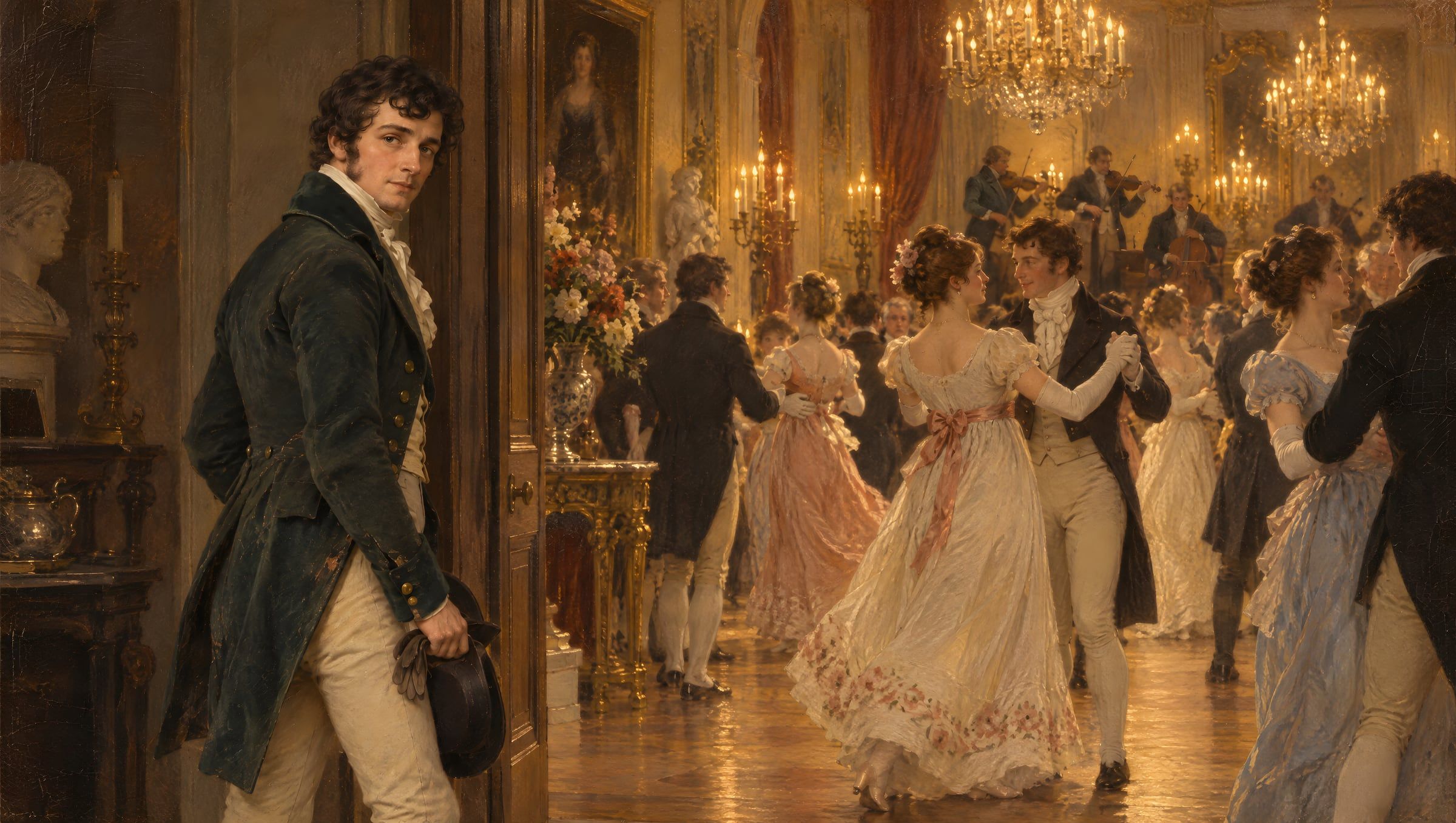
No. He needed someone to introduce him, and she could refuse. Routledge’s Manual of Etiquette, a cheap and widely sold book of about 1860, put the rule plainly: “Never present a gentleman to a lady without first asking her permission to do so.”2 At a Regency public assembly an introduction did not even last: “your acquaintance with the lady ceases with the dance,” and afterwards he could not address her “unless she should first bow.”3
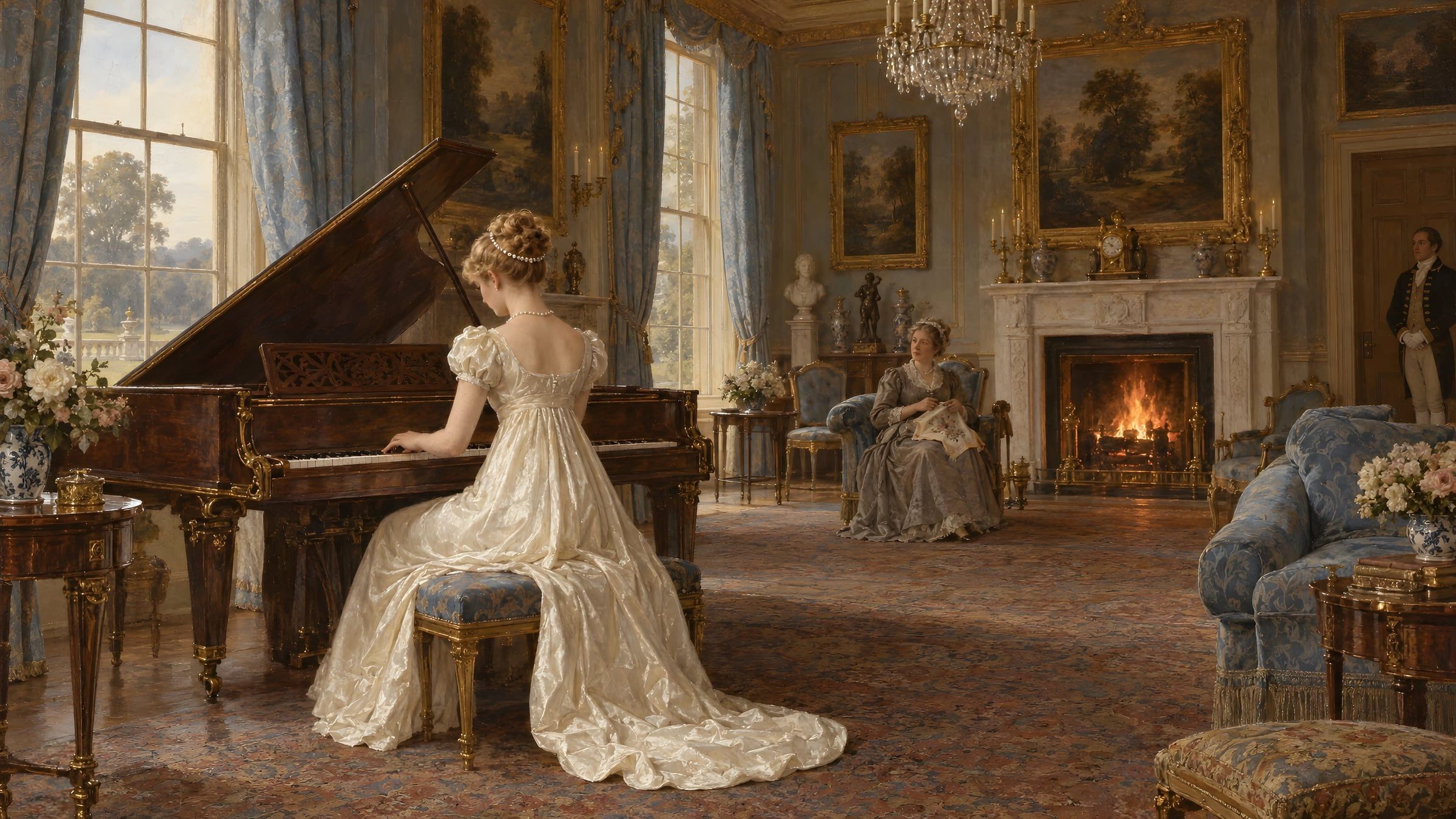
An unmarried woman went out with a chaperone, usually her mother or an older relative, who controlled who reached her.4 Even a call had a limit: “beware of letting your call exceed half-an-hour’s length.”2 An unmarried couple was not expected to correspond before an engagement, and Routledge ruled that even where they did, Christian names “should be avoided.”5
What could a look say?
A great deal, because the ordinary rule was restraint. “Always look, but never stare, at those with whom you converse,” Routledge advised.2 Against that, a held look could be read across a room. A dance manual of 1889 warned against keeping up “the telegraph of the eye and face a communication with others” on the floor.6
In public, recognition belonged to the woman. “It is the place of the lady to bow first,” the manual says; a gentleman was to “wait for her recognition before you venture to bow to her.”2 Refusing to see someone was the cut, and Francis Grose’s slang dictionary of 1811 lists four kinds, down to the cut infernal: “to analyze the arrangement of your shoe-strings” until the man has passed.7 The etiquette books made the rule run in women’s favor. A lady could cut a man, but “there are no circumstances under which a gentleman may ‘cut’ any woman who, even by courtesy, can be called a lady.”8
How did a calling card say yes or no?
By coming back. A calling card, a small printed card bearing a name, was left with the servant at the door and returned with a card within about ten days.9 A gentleman not yet introduced might send in his card. If the woman was interested she sent hers in return; if not, she sent his own card back to him in an envelope.10
Folded corners added a grammar. John H. Young’s Our Deportment of 1879 gives upper right for a visit, upper left for congratulation, lower left for condolence and lower right for taking leave.10 Other manuals disagreed, and by the century’s end the corner rules were described as a thing of the past.11
Why did people write across their own letters?
To save money. Before 1840 the cost of a letter depended on the distance and the number of sheets, and the person receiving it paid. An envelope counted as an extra sheet, so almost nobody used one.12 A London to Edinburgh letter of an ounce cost 4s 4d (a shilling, written s, was a twentieth of a pound; a penny, d, a twelfth of a shilling). That is about £27 today by retail prices, or $35, and more than a working man earned in a day.13
So writers filled a sheet, turned it ninety degrees and wrote across their own lines. In 1838 a woman named Spalding did exactly that in a letter to her sister; a second sheet would have doubled her postage to 2s 4½d, about £14 to £15 ($18 to $19) today by retail prices and about £127 ($162) measured against earnings.13 Members of Parliament could send and receive letters free, and people begged them for franked covers until the privilege was abolished on January 10, 1840.12
That same day Rowland Hill’s Uniform Penny Post began: a letter of half an ounce went anywhere in Britain for a penny, paid by the sender. From May 6 the Penny Black, with the young Queen’s profile, proved it had been paid.12 A penny in 1840 is about 51 pence today, or 65 cents.1
Before gummed envelopes a letter was sealed with wax or with a cheap paste disc called a wafer; Jane Austen’s surviving letters use wafers.14 Women cut compromising passages out with scissors or burned whole correspondences, and in breach of promise cases love letters were read aloud in court to “roars of laughter.”15
What did the penny post change for servants?
It gave them a private channel. A maid in service usually worked under a ban on “followers,” the period word for a sweetheart. In Elizabeth Gaskell’s Cranford the maid is “forbidden, by the articles of her engagement, to have ‘followers’,” and the narrator glimpses “a man’s coat-tails whisk into the scullery.”16 Mrs Beeton in 1861 recommended £9 to £14 a year plus board for a maid-of-all-work, the only servant in a small house. By a rough estimate, £9 then is about £1,200 to £1,300 ($1,500 to $1,700) today by retail prices, or about £9,000 to £11,000 ($11,500 to $14,000) against earnings.17 James Greenwood recorded one such day in 1883: work from six in the morning until “about seven,” when she could “get my apron off and make myself a bit tidy.”18
Working couples courted outdoors, “walking out” together on Sundays, and walking out with a young man was understood to be serious.19 Then came the penny letter, for those who could write: in 1840 about 67 percent of men and 51 percent of women could sign the marriage register.20 On August 18, 1892, the miner John Farrell wrote to Nelly Thistlethwaite, a servant: “My Dearest Nelly, I received your kind and welcome letter this morning and was very pleased to hear from you.”21 In Rossendale, Lancashire, about forty letters between Herbert Wilkins and Ethel Ormerod survive because she kept them in a Cadbury’s chocolate box; in one he warns her how easily letters “may be steamed open.”22
The penny also fed the valentine trade: about 400,000 were posted across England in 1841, and by the 1870s well over a million pieces of valentine mail passed through London on a single day.23 Dickens’s Household Words found “coarse caricatures and tender verses” in the sacks in 1850.24 The caricatures were “vinegar valentines,” a penny sheet with an insulting cartoon and verse sent anonymously to old maids, drunkards and later suffragettes: “A vote from me you will not get, / I don’t want a preaching suffragette.” Before prepaid postage, the person insulted paid to receive it.25 At the other end of the counter, a grand valentine of about 1860 cost three guineas (a guinea was £1 1s), about £400 ($510) today.1
Was the language of the fan real?
Fans were used to flirt, but the code was a sales leaflet. The London house of Duvelleroy, a Paris fan maker founded in 1827, printed The Language of the Fan to go out with its fans, calling the code centuries old. The first leaflet’s date is uncertain; the Metropolitan Museum’s copy was printed about 1924.26 G. Woolliscroft Rhead’s History of the Fan (1910) notes a code “published in English (duly copyrighted)” by Duvelleroy, different from the Spanish and German versions.27 An inherited tradition does not come with a copyright line.
The evidence most often quoted for an older code is a joke. Joseph Addison’s Spectator essay of June 27, 1711, begins “Women are armed with Fans as Men with Swords” and goes on as a mock drill: “Handle your Fans, Unfurl your Fans, Discharge your Fans.”28 Jonathan Walford of the Fashion History Museum puts it bluntly: “any naval flag-like language code based upon how a fan was opened, closed, held, or pointed is a complete fashion myth.”26
Did flowers have fixed meanings?
No. The fashion was real and huge, but meanings changed from book to book. It began with an Ottoman game called selam, from the Turkish for “greeting,” in which objects stood for words that rhymed with their names. Lady Mary Wortley Montagu described it from Constantinople in 1717, saying one could send “letters of passion” by it “without ever inking your fingers.”29 Her letters were printed in 1763, and Europe built something new on them. A Paris book of 1819 appeared under the pen name Charlotte de Latour, most often identified as Louise Cortambert, though not with certainty. English and American imitators followed, down to Kate Greenaway’s Language of Flowers in 1884.30
Beverly Seaton, whose 1995 history is the standard work, found not a shared code but “a vocabulary list, matching flowers with meanings, differing from book to book.”31 Collier’s Cyclopedia in 1882 gave hemlock a whole sentence, “You will be my death,” where Greenaway two years later gave it a short tag. A yellow rose stood for jealousy in many period books and later came to mean friendship.32
Where did the handkerchief, glove and stamp codes come from?
From print. The handkerchief code appeared in the late 1860s in Western Union’s house magazine, the Journal of the Telegraph, and a Baltimore compendium of 1877 gathered it with the glove and parasol codes. The lists share their wording, which shows one template copied across several props.33 The historian Mariah Gruner concludes that “the hiddenness of these codes was often more performative than lived, as newspapers would publish these lists.”33 The Postal Museum dates surviving “language of stamps” cards to around 1910 and notes that unless the receiver knew the same system, “the stamp is just at a funny angle.”34
What did carry a hidden message?
A few small things. The Fitzwilliam Museum holds a valentine of about 1850 to 1860 with a paper flower that lifts to show “G : LOVE” and a verse telling the reader to take one letter away; glove becomes love.35 The flower meanings that held steady across the books were the ones everyone already knew: rosemary for remembrance, myrtle for love, lily of the valley for the return of happiness.30 A lock of hair could go in a letter. In one, kept by the American Antiquarian Society, Minerva Walker copied out a poem and enclosed her hair with the line “Remember me when this lock of hair you see.”36
The real endings were mixed. John Farrell’s letters to Nelly close with a bastardy agreement of 1893 to pay toward a child’s keep.21 Herbert and Ethel married in 1904, once she turned twenty-one and no longer needed her father’s consent.22 And among the poorest, the neighbors’ recognition counted for more than any ceremony: one mother told the Foundling Hospital, “We have always been considered engaged.”19
Inside those rules, what you had was a very small vocabulary, used with great care, on one person at a time. Would you rather flirt where you can say anything and little of it costs you, or where you can say almost nothing and a single look is read perfectly? The question is open in the comments under the film on YouTube.
Sources and notes
Footnotes
-
Modern values use MeasuringWorth (Lawrence H. Officer and Samuel H. Williamson), UK relative-value calculator, real price (retail price index) measure, retrieved July 20, 2026, https://www.measuringworth.com/calculators/ukcompare/. The research used two target years, stated here per figure: pre-1840 postage on the 1835 base to 2023 (£1 of 1835 is about £124); the 1840 penny (£1 of 1840 is about £121.80) and the c.1860 valentine (£1 of 1860 is about £126.70) to 2024. The earnings figures for postage are MeasuringWorth’s labor-value measure on the same base. The 1861 servant’s wage was estimated, not computed directly, and is given as a rough range. Dollars are converted from those modern pound values at one fixed rate, the Bank of England’s 2024 annual average spot rate, US$1.2783 to £1 (series XUAAUSS), retrieved October 14, 2026, https://www.bankofengland.co.uk/boeapps/database/_iadb-fromshowcolumns.asp?csv.x=yes&Datefrom=01/Jan/2024&Dateto=31/Dec/2024&SeriesCodes=XUAAUSS&CSVF=TN&UsingCodes=Y&VPD=Y&VFD=N ↩ ↩2 ↩3
-
Routledge’s Manual of Etiquette (London: George Routledge, c.1860), Project Gutenberg ebook 12426, https://www.gutenberg.org/ebooks/12426 ↩ ↩2 ↩3 ↩4
-
Knowles, Regency History (2020), quoting period ballroom rules. ↩
-
hhhistory (2026) and historyanswers.co.uk (2021), on the chaperone’s role. ↩
-
Routledge’s Manual of Etiquette; Izabela Sakowicz (2023) on the Englishwoman’s Domestic Magazine, https://doi.org/10.4467/23916001HG.23.014.18815 ↩
-
Charles Greene, Greene’s Terpsichorean Monitor (1889), Library of Dance transcription. ↩
-
Francis Grose, 1811 Dictionary of the Vulgar Tongue, entry “Cut.” ↩
-
History.com (2025) on the cut in nineteenth-century etiquette; Emily Post, Etiquette (1922). ↩
-
Debrett’s (2023) and literary-liaisons, on calling-card practice. ↩
-
John H. Young, Our Deportment (1879), as reproduced by the Kent-Delord House Museum and others. ↩ ↩2
-
Dempsey and Carroll; Hoban Cards, on the short life of the corner-fold rules. ↩
-
The Postal Museum, “Rowland Hill’s postal reforms,” “Uniform Penny Postage” and “Penny Black,” https://www.postalmuseum.org/; Great Britain Philatelic Society, pages on franking, https://www.gbps.org.uk/; Smithsonian National Postal Museum, https://postalmuseum.si.edu/ ↩ ↩2 ↩3
-
The Postal Museum; Victorian Web postal rate tables; Shanahan on cross-writing, Victorian Web, https://victorianweb.org/ ↩ ↩2
-
Period seal and wafer guides digested by Golden Romance, Victorian Passage and “Her Reputation for Accomplishment.” ↩
-
Amanda Kalenak, Journal of Victorian Culture 28, no. 2 (2023): 243-62, https://doi.org/10.1093/jvcult/vcad006; Sakowicz (2023). ↩
-
Elizabeth Gaskell, Cranford (1851-53), ch. 3. ↩
-
Isabella Beeton, The Book of Household Management (London: S. O. Beeton, 1861), wage table, via victorianlondon.org. ↩
-
James Greenwood, Toilers in London (1883), “The Maid of All Work,” via victorianlondon.org. ↩
-
Florence Pellegry, Tropics (2022), https://doi.org/10.61736/tropics.526; Frost, Promises Broken (1995). ↩ ↩2
-
Our World in Data, historical literacy in England, from marriage-register signatures. ↩
-
Cumbria Archives, “Age of Emotion,” Farrell and Thistlethwaite letters, 1892-93, https://www.cumbriaarchives.org.uk/ ↩ ↩2
-
Lancashire Archives, Wilkins and Ormerod letters, c.1898-1904, as reported in the Lancashire Telegraph (2012). ↩ ↩2
-
London Museum, “Quirky Victorian Valentine’s Day cards,” https://www.londonmuseum.org.uk/; Victorian Web, “Love and Derision ‘By the Bushell’,” citing Mancoff, The Victorian Valentine. The exact 1871 total is disputed (1.2 million, or 1.5 million extra items on February 14 in the Postmaster General’s report). ↩
-
“Valentine’s Day at the Post-Office,” Household Words (1850), via Victorian Web. ↩
-
Annebella Pollen, quoted in Smithsonian Magazine; The Conversation (2026) for the suffragette verse. ↩
-
Jonathan Walford, “Myth Information: The Fan Code,” Fashion History Museum, March 7, 2022, https://fashionhistorymuseum.com/; ASU FIDM Museum on Maison Duvelleroy; Metropolitan Museum of Art, “Fanmania” exhibition text (2024-25). ↩ ↩2
-
G. Woolliscroft Rhead, History of the Fan (1910), Project Gutenberg ebook 46136, https://www.gutenberg.org/ebooks/46136 ↩
-
Joseph Addison, The Spectator, no. 102, June 27, 1711. ↩
-
Lady Mary Wortley Montagu, letter from Constantinople, 1717, printed 1763; on selam as a rhyming object game, Cornell University Library, “Written in Petals,” https://rmc.library.cornell.edu/ ↩
-
Charlotte de Latour [pseud.], Le Langage des Fleurs (Paris: Audot, 1819), Biodiversity Heritage Library, which attributes it with caution to Louise Cortambert (a 2023 French reissue names Louis-Aimé Martin); Kate Greenaway, Language of Flowers (London: George Routledge and Sons, 1884). ↩ ↩2
-
Beverly Seaton, The Language of Flowers: A History (University Press of Virginia, 1995). ↩
-
Collier’s Cyclopedia (1882), as reproduced by Futility Closet; Greenaway, Language of Flowers; Jemma Stewart, “An ‘Electric Telegraph’ of the Heart,” Birkbeck ePrints. ↩
-
Mariah Gruner, “Materiality, Affect, and the Archive” (2019), https://doi.org/10.7202/1062472ar; Cowper and Newton Museum, on the Journal of the Telegraph and Daniel R. Shafer’s compendium (Baltimore, 1877). ↩ ↩2
-
The Postal Museum, “Victorians’ Secret Ways of Keeping in Touch,” https://www.postalmuseum.org/ ↩
-
Fitzwilliam Museum, Cambridge, Glaisher collection, cryptogram valentine P.14414-R-53, https://data.fitzmuseum.cam.ac.uk/ ↩
-
American Antiquarian Society, Worcester, Massachusetts, letter of Minerva Walker (after 1825), https://www.americanantiquarian.org/ ↩