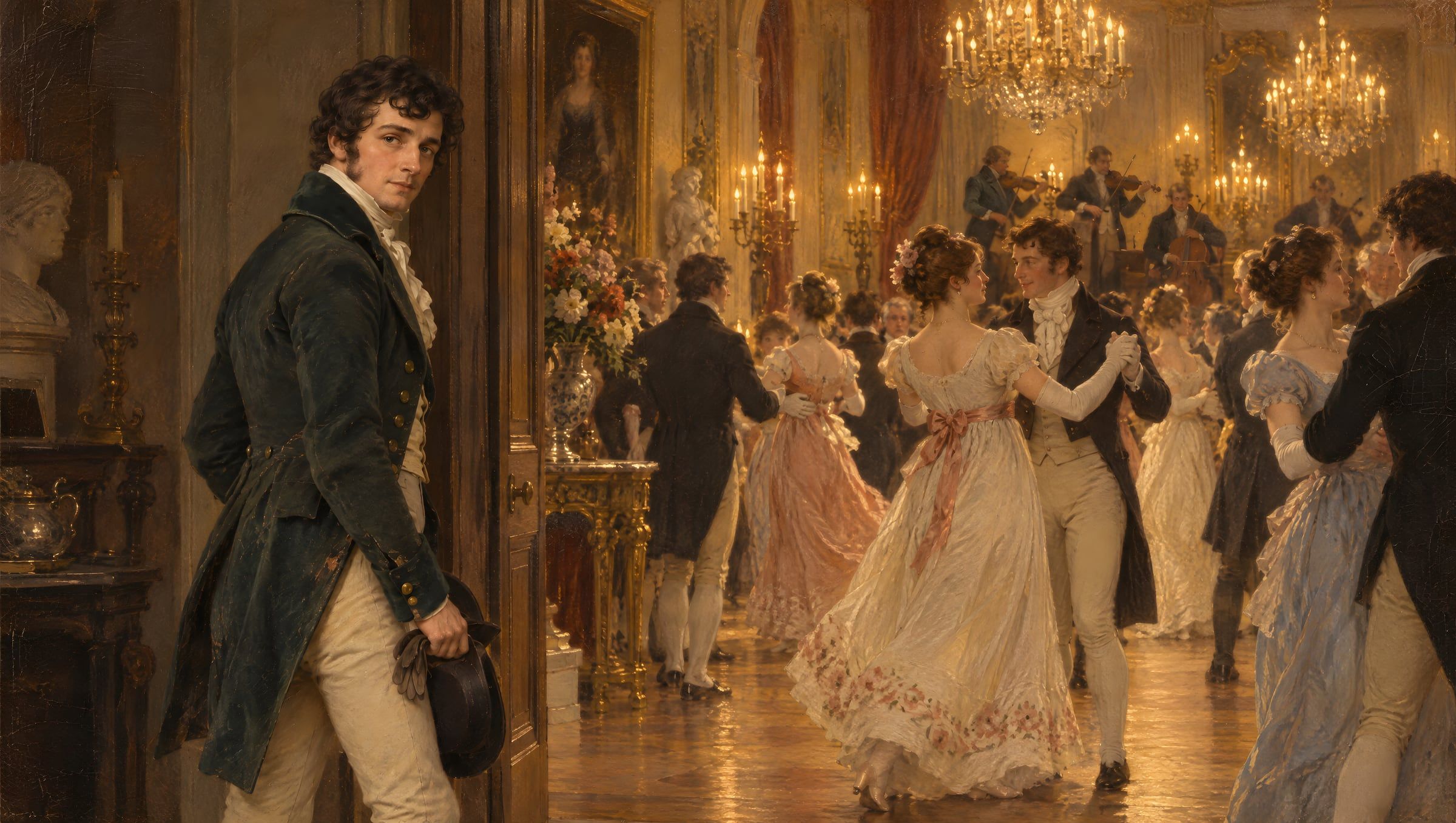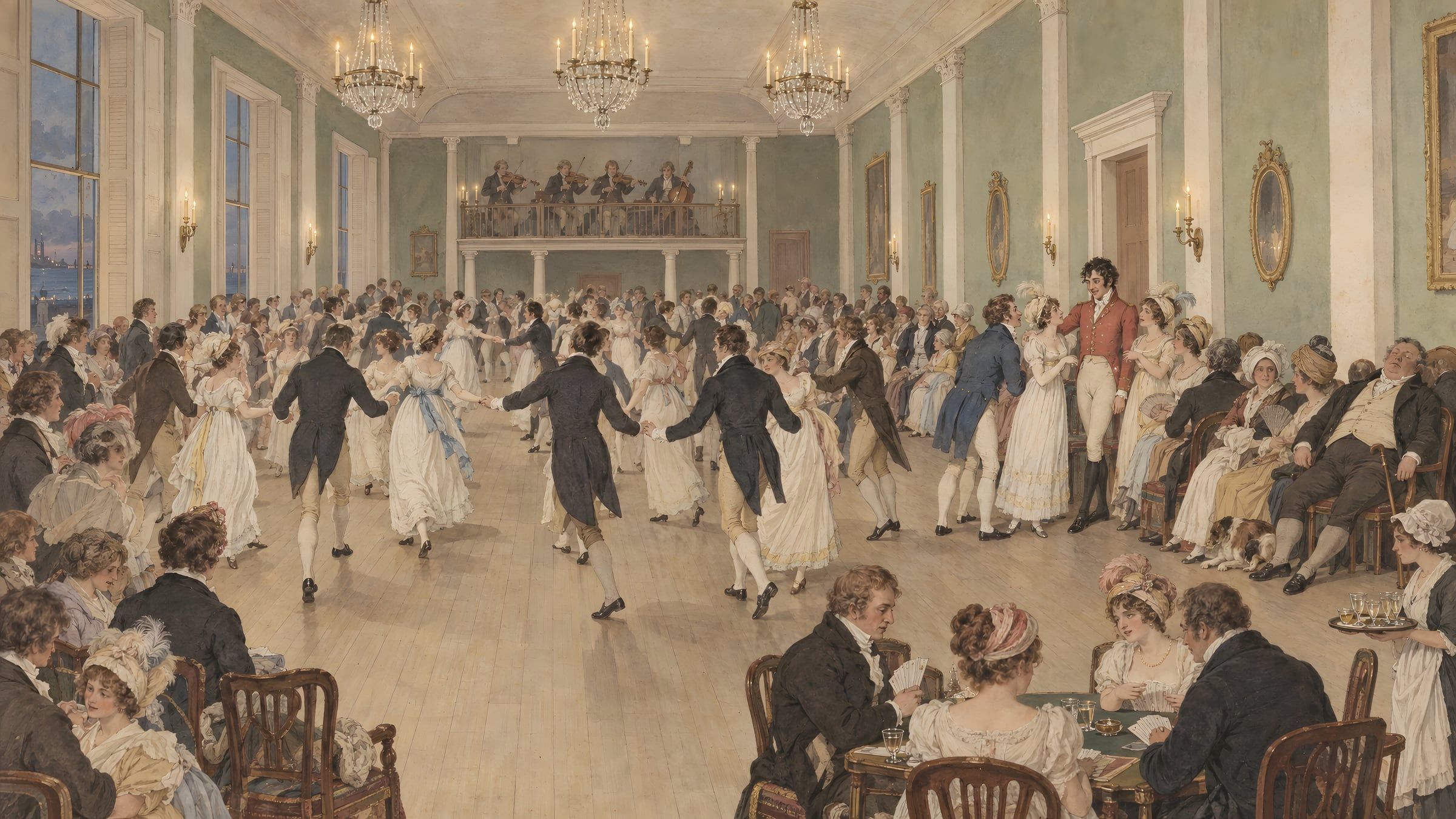
Colonel Brandon lost Eliza because she was rich and his family was in debt. At seventeen she was married against her will to his brother, the heir, by the uncle who was her guardian, because “her fortune was large, and our family estate much encumbered.” The marriage ended in divorce about two years later, the fortune stayed behind, and Brandon found her years afterward in a bailiff’s lock-up, dying of consumption. By the novel’s own clock she was about twenty-two.1
Austen tells this in one speech in chapter 31 of Sense and Sensibility and gives Eliza no surname and no dates. Every step of it, though, has a counterpart in the record, and two real women of the same decades wrote their side down: Elizabeth Gooch, in a memoir of 1792, and Elizabeth Vassall, Lady Webster, in her journal. Neither is “the real Eliza,” and nothing ties either to Austen. Every sum is converted the same way, explained in note 1.2
A ward with a large fortune
Brandon describes her as “one of my nearest relations, an orphan from her infancy, and under the guardianship of my father,” and says, “I cannot remember the time when I did not love Eliza.” His father was her uncle as well as her guardian, and he married her to his own heir. An encumbered estate was a mortgaged one, and her money would prop it up.1
No documented case of a guardian marrying his ward to his own son has been found, but readers knew the type: in Fanny Burney’s Cecilia (1782), the heiress’s guardian “took care to put his son enough in her way.”3 What the law gave a guardian was a veto. Since 1754, a marriage by license of anyone under twenty-one without the consent of the father or guardian was “absolutely null and void,” but the act did not reach Scotland.4 Brandon and Eliza were “within a few hours of eloping together for Scotland” when “the treachery, or the folly, of my cousin’s maid betrayed us.” He was sent away, and she “was allowed no liberty, no society, no amusement, till my father’s point was gained.”1
Real guardians used the same locks. In 1794 the guardians of the Duke of Chandos’s daughter, an heiress, moved her to Twickenham to “confine her closely,” opened her letters, and warned the servants that anyone who carried a message for her would be sent to Newgate. The servants were the only way a letter could leave that house.5 Mrs Gooch, an heiress in her teens, was pressed by words instead. When she told Mr Gooch before the wedding that she wished to break it off, he answered that it “should be the ruin of my character, and the loss of half my fortune, for which he would sue me.” She married him five weeks after they first met.6
Once married, a woman was absorbed into her husband in law. William Blackstone put it in 1765: “the very being or legal existence of the woman is suspended during the marriage.” Her ready money became his outright, and Austen mentions no settlement that might have protected Eliza’s.7
When the marriage ended, the money stayed
Her husband, Brandon says, “did not deserve her; he did not even love her.” His father died a few months after the wedding, and Brandon was “with my regiment in the East Indies,” having “procured my exchange” to put years between them. Many officers with money paid to get out of regiments bound for India; Brandon arranged to be sent.1 Left with “such a husband to provoke inconstancy, and without a friend to advise or restrain her,” she fell, and “about two years afterwards” he heard of her divorce.
Austen does not say how it was done, and the usual road gave the wife little part. The first trial was not brought against her. Her husband sued the other man for damages in an action called criminal conversation, which, in the historian Lawrence Stone’s words, “was carried on exclusively between the two men.” She could not call witnesses or testify in her own defense, and her adultery was usually proved by servants: a chambermaid at a keyhole, a cook called up at night.8
Ending the marriage took a private Act of Parliament. There were about 320 between 1700 and 1857, nearly all brought by husbands, and no wife’s bill passed until 1801.9 When an Act passed, the wife forfeited “her marriage portion, … her pin-money and her widow’s jointure”: the fortune she brought, her spending allowance and her income as a widow. “After 1700,” Stone writes, “the husband always kept his wife’s marriage portion,” and settled a yearly allowance on her in return.10
Mrs Gooch’s husband tried that road while she lived in France. Told that two witnesses were needed, she hired a cook, who then saw her in bed with a French officer, and Lord Thurlow suspected collusion. On March 12, 1781, the Lords rejected the bill by 14 votes to 13. She stayed married and separated, on £200 a year (about £30,000, or $38,000, today), paid quarterly at Hoare’s bank in Fleet Street. Her husband held the rest of her money.11 12
The plainest record of who kept a fortune is Lady Webster’s. Married at fifteen in 1786 to a man about twenty-three years older, she wrote on the anniversary in 1793: “This fatal day seven years gave me, in the bloom and innocence of fifteen, to the power of a being who has made me execrate my life since it has belonged to him.” By then she had inherited Jamaica estates worth about £7,000 a year by 1800 (about £760,000, or $970,000, today). Parliament ended the marriage on July 4, 1797. “On the fifth I signed a deed by which I made over my whole fortune to Sir G. W., for our joint lives, for the insignificant sum of 800l.” That is £800 a year (about £87,000, or $111,000, today). On the sixth she married Lord Holland.13
Held for debt
When Brandon came home nearly three years later, he learned that “her legal allowance was not adequate to her fortune,” and that “the power of receiving it had been made over some months before to another person.” His brother supposed she had sold it for cash to pay her debts, “and calmly could he imagine it.”1 Mrs Gooch’s memoir records the same bargain in her own hand: “I made over to him a power of attorney to receive the half of every quarter’s annuity until the whole was paid.” The man had paid off one of her creditors.14
The novel says only that Brandon had “every reason to fear that she had removed from him only to sink deeper in a life of sin.” That is a fear, and the word prostitution appears nowhere in the book. Stone lists the paths open to such a woman: marry her lover, live as a kept mistress, or fall into common prostitution.15
If you owed money in London in the 1780s, you could lose your liberty without a trial. A creditor swore that you owed him, a writ was issued, and the bailiff came; fewer than one debtor in five ever saw a courtroom. He took you first to his own lock-up, the spunging-house, where, by Francis Grose’s slang dictionary of 1785, prisoners stayed “till they find bail, or have spent all their money.” A woman divorced by Act had no husband to answer for her debts.16
Mrs Gooch knew these houses. In November 1787 she spent two days in one, “this den of extortion and captivity,” and was sent on to the Fleet prison for £210 owed to five creditors (about £28,500, or $36,400, today). Among the debts was a harpsichord. Writing to raise money for her release, she said she was “oppressed by Mr Gooch, forsaken by my family, and destitute of friends.” Someone paid in September 1788.17
A servant led Brandon to Eliza. He went to a spunging-house to visit “a former servant of my own, who had since fallen into misfortune,” and found “in the same house, under a similar confinement,” his “unfortunate sister. So altered—so faded—worn down by acute suffering of every kind!” She was “in the last stage of a consumption,” tuberculosis of the lungs, for which doctors could offer rest, fresh air, good food and opium.18 He moved her to “comfortable lodgings,” visited her every day, and was “with her in her last moments.” She left him a daughter of about three, whom he placed at school.1
It happened again
The girl was named Eliza too. At about sixteen she went to Bath with a friend and vanished. When Brandon found her she was “near her delivery,” and the man was Willoughby, the young man Marianne Dashwood loved. He had left her “with no creditable home, no help, no friends, ignorant of his address,” and “he neither returned, nor wrote, nor relieved her.”19
The law gave her almost nothing. The one lawsuit for seduction belonged to her father or guardian, who could sue for the loss of her “service,” as if she were a maid who could no longer work. William Paley wrote in 1785 that “not one half of the crimes, for which men suffer death by the laws of England, are so flagitious as this.”20 The novel never says what became of the child. Brandon’s verdict is one sentence: “Such has been the unhappy resemblance between the fate of mother and daughter!”19
Thirty-five and seventeen
At thirty-five Brandon met Marianne, aged seventeen, and saw in her “a very strong resemblance” to Eliza: “The same warmth of heart, the same eagerness of fancy and spirits.”1 Austen lets her characters argue the ages. Marianne decides that “thirty-five has nothing to do with matrimony,” and Elinor answers that “thirty-five and seventeen had better not have any thing to do with matrimony together.”21
Real marriages of this class rarely looked like theirs. Studies of gentry marriages and marriage licenses put husbands usually less than three years older than their wives; wide gaps occurred mostly when an older man married a second time.22 Two women who married much older men left their own verdicts. Mary Delany, married at seventeen in 1718 to a man near sixty, wrote, “I was sacrificed.” Hester Thrale, about twenty-two to her husband’s thirty-five, called it “a Match of mere Prudence,” yet wrote that God “knows I did love him dearly.”23 One historian concluded that wide gaps “did not always lead to the emotional disasters predicted by contemporary writers.”24 Marianne married Brandon at nineteen.21
Eliza was married at seventeen because she was rich. When the marriage was thrown away her fortune stayed behind, and she was left an allowance “not adequate” to it. Mrs Gooch was left £200 a year; Lady Webster signed her whole fortune away for £800. The film closes by asking viewers whether, in their own lives, they have known a Willoughby or waited for a Brandon, and the answers are in the comments on YouTube.
Footnotes
-
Jane Austen, Sense and Sensibility (London: T. Egerton, 1811), vol. 2, ch. 9 (modern ch. 31), text from Project Gutenberg #161, https://www.gutenberg.org/files/161/161-h/161-h.htm, checked against the first edition, https://archive.org/details/sensesensibility131aust. Eliza’s ages are derived from the intervals Brandon gives (married at seventeen, divorced about two years later, found nearly three and a half years after that); Austen states no years. The point about officers paying to leave India-bound regiments is from Edward Ingram, “The role of the Indian Army at the end of the Eighteenth Century,” Military History Journal 2, no. 6 (1973), https://www.samilitaryhistory.org/vol026ei.html. ↩ ↩2 ↩3 ↩4 ↩5 ↩6 ↩7
-
Modern values are those in the episode’s research file, which uses one method throughout: the UK inflation multipliers of Wikipedia’s
{{Inflation|UK}}template (Gregory Clark’s price series joined to the ONS consumer price index), in 2025 pounds, rounded. A price index measures what money would buy, so these figures are a floor; against wages of the day the sums meant roughly ten times more. Dollars are converted from those modern pounds at one fixed rate, the Bank of England’s 2024 annual average spot rate, $1.2783 to £1 (series XUAAUSS, https://www.bankofengland.co.uk/boeapps/database/_iadb-fromshowcolumns.asp?csv.x=yes&Datefrom=01/Jan/2024&Dateto=31/Dec/2024&SeriesCodes=XUAAUSS&CSVF=TN&UsingCodes=Y&VPD=Y&VFD=N, retrieved October 14, 2026). Old money: a shilling (s) was a twentieth of a pound; “800l.” is the period way of writing £800. ↩ -
Frances Burney, Cecilia (1782), bk. 9, ch. 6, https://en.wikisource.org/wiki/Cecilia/Book_9/Chapter_vi. The absence of a documented case is a negative finding of the episode’s research. ↩
-
Clandestine Marriages Act 1753 (26 Geo. 2 c. 33), ss. 11 and 18, https://statutes.org.uk/site/the-statutes/eighteenth-century/1753-26-geo-2-c-33-prevention-of-clandestine-marriages/ ↩
-
J. V. Beckett, “Love and Marriage among the English Aristocracy: the Buckingham-Chandos Alliance of 1796,” Records of Buckinghamshire 34 (1994): 101-6, http://www.bucksas.org.uk/rob/rob_34_0_101.pdf ↩
-
The Life of Mrs. Gooch, Written by Herself, 3 vols. (London, 1792), vol. 1, about pp. 47-57, https://archive.org/details/bim_eighteenth-century_the-life-of-mrs-gooch-_gooch-elizabeth-sarah-v_1792_1. Quoted from OCR; page images not yet checked. It is a self-justifying memoir. Her birth date, and so her age at marriage, is disputed: seventeen by one secondary birth date, nineteen according to Alexander Wakelam (note 15). ↩
-
William Blackstone, Commentaries on the Laws of England, bk. 1, ch. 15 (1765), https://avalon.law.yale.edu/18th_century/blackstone_bk1ch15.asp; bk. 2, ch. 29. ↩
-
Lawrence Stone, Road to Divorce: England 1530-1987 (Oxford University Press, 1990), 31, 234. The keyhole and the late-night cook are from Trials for Adultery (London, 1779-80) and the Gooch debate (note 11). ↩
-
The National Archives, “Divorce” research guide, https://www.nationalarchives.gov.uk/help-with-your-research/research-guides/divorce/ (“around 320”); UK Parliament gives 314 and Stone’s table 322. The first wife’s bill passed in 1801: History of Parliament, “Jane Campbell: Parliamentary divorce pioneer” (2016), https://historyofparliament.com/2016/10/05/jane-campbell/ ↩
-
Stone, Road to Divorce, 324, 345. ↩
-
Cobbett’s Parliamentary History of England, vol. 21 (London, 1814), debate in the Lords on Gooch’s divorce bill, about cols. 1207-24, https://archive.org/details/10279129bsb (OCR); Stone, Road to Divorce, 331-32; Life of Mrs. Gooch for her sentence. Several reference works say wrongly that she was divorced in 1781; the bill was rejected. ↩
-
Life of Mrs. Gooch, vol. 2, about p. 7 (OCR). Her husband’s control of her fortune: Wakelam, “Coverture and the Debtors’ Prison” (note 15). ↩
-
The Journal of Elizabeth Lady Holland (1791-1811), ed. the Earl of Ilchester (1908), vol. 1, p. 53 and the editor’s introduction, Project Gutenberg #73222, https://www.gutenberg.org/files/73222/73222-h/73222-h.htm; History of Parliament, “Webster, Sir Godfrey, 4th Bt. (1748-1800),” https://www.historyofparliamentonline.org/volume/1754-1790/member/webster-sir-godfrey-1748-1800 ↩
-
Life of Mrs. Gooch, vol. 3, about p. 78 (OCR; page markers can be off by one). ↩
-
Stone, Road to Divorce, 341-42. For Mrs Gooch’s debts and income: Alexander Wakelam, “Coverture and the Debtors’ Prison in the Long Eighteenth Century,” Journal for Eighteenth-Century Studies 44, no. 4 (2021): 343-60 https://onlinelibrary.wiley.com/doi/full/10.1111/1754-0208.12801 ↩
-
Wakelam, “Coverture and the Debtors’ Prison”; Francis Grose, A Classical Dictionary of the Vulgar Tongue (1785), s.v. “spunging house,” https://archive.org/details/bim_eighteenth-century_a-classical-dictionary-o_grose-francis-f-a-s_1785. That a woman divorced by Act had no husband liable for her debts is an inference from Blackstone and Wakelam; no named case of such a woman arrested for debt has been found. ↩
-
Life of Mrs. Gooch, vol. 2 (OCR); Wakelam, “Coverture and the Debtors’ Prison,” citing the Fleet commitment register (The National Archives, PRIS 1/13) and An Appeal to the Public, on the Conduct of Mrs. Gooch (1788), 66. ↩
-
Lisetta Lovett, “Dr Erasmus Darwin’s Management of Consumption,” Topics in the History of Medicine 5 (2025): 156-77, https://bshm.org.uk/wp-content/uploads/2025/12/thom-v5-156-177.pdf. One scholar, Marie McAllister, reads Eliza’s “consumption” as a euphemism for syphilis: Eighteenth-Century Fiction 17, no. 1 (2004): 87-110. ↩
-
Austen, Sense and Sensibility, ch. 31. Eliza Williams’s age is derived from the text. ↩ ↩2
-
William Paley, The Principles of Moral and Political Philosophy (1785), quoted from the 1799 edition, vol. 1, pp. 307-8, https://archive.org/details/bim_eighteenth-century_the-principles-of-moral-_paley-william_1799_1. The first edition was not checked. His word is “flagitious”; a version with “villainous” circulates. ↩
-
Hugh Gareth Davies, “Marriage Strategies of Midlands ‘Lesser Gentry’, c.1660-1820” (MPhil thesis, University of Warwick, 2018), 112-13, 182, 239, https://wrap.warwick.ac.uk/id/eprint/102069; R. B. Outhwaite, “Age at Marriage in England from the late Seventeenth to the nineteenth Century,” Transactions of the Royal Historical Society 23 (1973): 55-70. No source consulted says how common an eighteen-year gap was. ↩
-
The Autobiography and Correspondence of Mary Granville, Mrs Delany, ed. Lady Llanover, vol. 1 (1861), about pp. 27-30, https://archive.org/details/autobiographyimg01dela; Hester Lynch Piozzi, Thraliana, ed. K. C. Balderston (Oxford, 1942), vol. 2, p. 692, entry for October 11, 1787. Both quoted from OCR. ↩
-
Davies, “Marriage Strategies,” 113. ↩